
The 60 seconds where it's decided
An academy recruiter watching reels in the evening will give your child somewhere between 30 and 90 seconds before they form a view. That is the entire window. Not the match. Not the season. A minute on a phone screen in the corner of a kitchen.
The reel that comes off the back of a Veo download — the one most parents try to make in DaVinci or CapCut and then abandon — has to do a specific job in that minute. It has to convince a scout that they should put your child's name into their next conversation. Not sign them. Not invite them in. Just look again.
That's a much smaller bar than it sounds. But a generic compilation of touches, scored to a hyped-up backing track, does not clear it. Scouts watch a lot of compilations. The reels that get a second look have specific things in common — and once you know what those things are, the editing job becomes a lot more answerable than "cut something good."
The four corners — what a scout is actually filling in
English academy recruitment, from grassroots talent ID up through Cat 1, runs on the same mental framework the FA teaches at every coaching badge: the four-corner model. When a scout watches your child play, they are answering four questions:
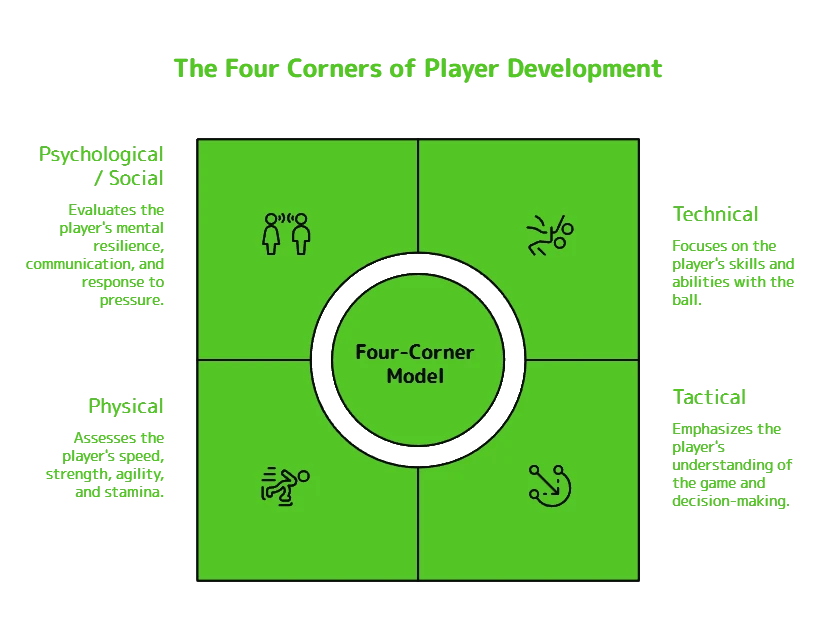
- Technical — can they do the things? Touch, passing, finishing, ball mastery, weak foot.
- Tactical — do they know what to do? Decision-making, awareness, positioning, game intelligence, scanning before they receive.
- Physical — do they have the engine? Speed, strength for their age band, agility, stamina across 80 minutes.
- Psychological / social — do they have the head for it? Resilience after a mistake, communication, body language, response to pressure.
A 60-second reel has to put at least one piece of evidence into each corner. Six touches that all evidence the same corner — six dribbles, six finishes — is not a reel a scout reaches a verdict on. It's a clip of someone showing off. The reel that lands tells the scout: your child has the touch, knows where the gap is, can sprint to it, and didn't drop their head when they missed the first one.
The four things that separate a scout reel from a montage
You can't put four corners on screen if the scout can't see your child to begin with. Veo records the whole pitch from a fixed point at the halfway line. Your child is, charitably, a 12-pixel blob in the wide. The standard montage workflow — drop wide-angle clips onto a timeline, crossfade, add music, render — produces a reel that nobody finishes watching.
The four moves that change that:
1. Lock the frame on the player
The single most important change is also the one almost no parent bothers with, because doing it in DaVinci is a weekend lost to motion-tracker tutorials. The frame needs to follow your child across the pitch — either by cropping tight onto wherever the action is, or by literally tracking their run with a moving box and a coloured outline so the scout's eye never has to hunt for them.
In ReelMagic this is one click and one mouse drag: drop a marker on the player, hold and follow them while the video plays slow. The outline animates along their path in the export. For static plays — a corner, a free kick, a tap-in — a fixed focus box crops the wide Veo frame down to where it matters. Either way: when the scout's eye lands on the screen, your child is centred. They never have to look for the player.
2. Slow the skill moment down so it lands
The technical corner is invisible at full speed. A defender doesn't see the shift in body shape before the turn. A scout doesn't see the cushioned touch that killed a 30-yard ball. Slow-motion isn't cinema — it's the only way to make a U13's technical work readable to someone watching at arm's length on a phone.
The rule of thumb: slow the touch, not the run-up. A whole clip at 0.5× is sluggish and oddly emotional. A touch at 0.5× is what gets the scout to nod. Half a second of slow-mo per clip is plenty; in ReelMagic the per-clip slider runs from 0.25× to 1×, and you can apply it to a clip without re-cutting.
3. Add a backing track and a clean fade
Match audio is unusable. Wind, the dog walker shouting at the linesman, your own voice on the sideline. The reels a scout finishes watching all have one thing in common: a track. Doesn't have to be hyped — actually, the calmer the better for evidencing technical work — but it has to be there. A track raises the percentage of scouts who watch past clip three. That's the conversion you're after, not "sounds cool."
One song across the whole reel, with a half-second fade at the end so it doesn't clip. ReelMagic does this on a sequence-wide pill on the bottom bar; you don't re-render per clip.
4. Lift the picture for floodlit / fog / sun-blown Veo
Half of UK youth football is played in conditions that make the Veo footage look like a 1990s VHS. A 5pm kickoff under floodlights, a foggy Saturday, a low winter sun directly behind the goal. The recording works, but it looks grim — and grim footage flattens the perception of the player on it.
A small brightness lift (+15 to +25%) on the whole reel rescues most of these. It's a one-slider job on the sequence bar. Doesn't fix everything; does fix "why does my kid look like a silhouette."
What every reel needs, regardless of position
Before you get to the position-specific stuff: every reel a scout watches has the same skeleton.
- Six to ten clips. Six is on the short end; ten is generous. Twelve is too many — by clip eight a scout is making a sandwich.
- 30–60 seconds total. Closer to 60 than 30. A 90-second reel better be exceptional from start to finish.
- Name, DOB, position, and the club on the first clip or the outro. A scout watches dozens of reels a week. The one without the kid's details gets parked.
- The strongest two clips at the front.The first ten seconds is where a scout decides whether to watch the rest. Don't save the goal for the end.
- A defensive contribution, even if your child is a forward. Especially if your child is a forward. The four-corner brief always asks: do they work without the ball?
Position-specific is where the work pays off
A scout watching a #9 is filling in a different brief from the scout watching a left-back. The clips that evidence a striker's case do not evidence a centre-back's. This is the most common reel mistake we see: the same six clips uploaded for every position, when half of them aren't relevant to the role the child plays.
The position-specific guides below break down what a Cat 1 and 2 academy is filling into the four corners for each role, and the specific clip types you should hunt for in your Veo footage to fill them. Each one ends with a downloadable checklist you can take to the next match and tick off as the season runs.
Free download
Or get the whole thing in one PDF
Every position checklist bundled together. Print it, scribble on it, share it with your child's coach.
Getting the reel in front of someone who matters
An unwatched reel and an unmade reel produce the same outcome. The distribution side gets less attention than the editing side, but it's where the actual return on all this work lives. The short version:
- A per-child Instagram account with a handle the kid can carry through their career, all reels in one feed, scout-friendly hashtags, club tagged in every post.
- Direct outreach to academy recruitment officers on LinkedIn — they are mostly findable, mostly respond to short specific messages, and almost never respond to mass cold messages.
- The football-parent Facebook groupsthat have actual scouts in them — not the ones full of parents shouting at refs. There's a real difference.
- The coach network.Your child's current and previous coaches know people. A reel given to a coach with "could you forward this if you think it's worth a look" is the single highest-trust route into a scout's inbox.
The distribution playbook with templates and contact patterns is coming as the next cluster of articles. The position checklists are what to make; the distribution guides are what to do with them.
The honest economics
Most academy-pathway parents we know are spending hundreds a month on training, travel, kit and club fees. The reel is the cheapest thing in that stack — and the one that, when it's made, sits permanently on a scout's screen rather than dissolving with the final whistle. The economics massively favour making the reels. The reason they don't get made isn't cost — it's the editing tools being awful. Which is why we built ReelMagic.
The app is in early-access pilot now, with a founding-member discount for everyone who joins the list before public launch in 2026/27. Join the list here. No card, no spam, just the email when it opens.